Trees Have Roots; Waters Have Sources

Highlights from the book I Am Not a Monk “Sponging Off” Buddhism, by Venerable Master Hsing Yun

Trees Have Roots; Waters Have Sources A Brief Description of My Relations and Hometown

Trees have their roots, and people have their origins. As hu­man beings, we must endeavor to increase joy in the world for the sake of everyone in the world, and we also must ensure that life will sprout flowers and bear fruits as strong and stur­dy as the peach. “Mother” is the source of life for every person, and she is also the harbor on which each person depends for their first contact with the human world. The conduct and vir­tue of the world’s mothers in compassionately dealing with the world and wisely managing the household affairs all become the nutrients for life during our time on Earth.

When I was a child, someone asked me, “Where do you live?” I said, “In Xiannü Temple Town.”

As a young person joining the monastic order in Nanjing, people would also frequently ask me where I was from, and I would say, “I am from Jiangdu District in Yangzhou.”

Yes, I was born in a small town, Xiannü Temple Town, in Yangzhou, Jiangsu Province, China. It was about six miles from Yangzhou city.

I was born and raised during that period when war raged all around, streets and alleyways were mostly destroyed, and rubble was everywhere. At the end of 1937, the Japanese Army had occupied Nanjing, and we suddenly lost contact with my father, who was doing business in Nanjing. In early spring of 1938, my mother took me to Nanjing in search of my father’s whereabouts, and I met a monastic from Qixia Monastery who asked me whether I was willing to join the monastic order and become a monk. I answered, “Yes!” Thus, I joined the monastic order.

Since this had to do with the search for my father, the causes and conditions for my joining the monastic order could be regarded as having been bestowed by my father. “Trees have roots; waters have sources” means that every event and every person all have their origins. The family relations on my father’s side and my mother’s side are the source of my blood relationships, so I will trace back some events related to my family and my hometown, in order to show what I commemo­rate and feel thankful for in my life.

  • My Mother, Liu Yuying—The Grandma of a Big Family

Having never studied and being illiterate, my mother could still recite lines of poetry that left one deep in thought; for example:

Wilted lotuses no longer possess the canopies holding off rain;
Faded chrysanthemums still have their branches so proud in the frost.

This is a couplet from Su Dongpo’s [1037–1101] poetry that I heard her recite aloud decades ago. In fact, not only did she recite this verbally and mentally, but my mother even spent her entire life putting the meaning of these couplets into prac­tice. Consequently, it was also no wonder that she could just about produce an impromptu comment on just about any topic from astronomy to geography.

My childhood was spent with my mother as we lived through hard times, yet my optimistic mother did not feel any hardship despite our poverty. I never saw her express any worry or sadness due to poverty. She often told us that a per­son must be able to be poor but not be destitute.

If one sees the dazzling array of items on sale but has no wish to buy them, then they are considered a person of wealth. In view of this notion, throughout her life she never enjoyed buying, nor did she enjoy acquiring things. On many occasions when there was a bit more money in the house than usual, she would im­mediately exchange it for a lot of loose change and give it to people in need, making donation to form affinities. Her reason­ing was, “A penny can hound a hero to death, yet a penny can save a hero too.”

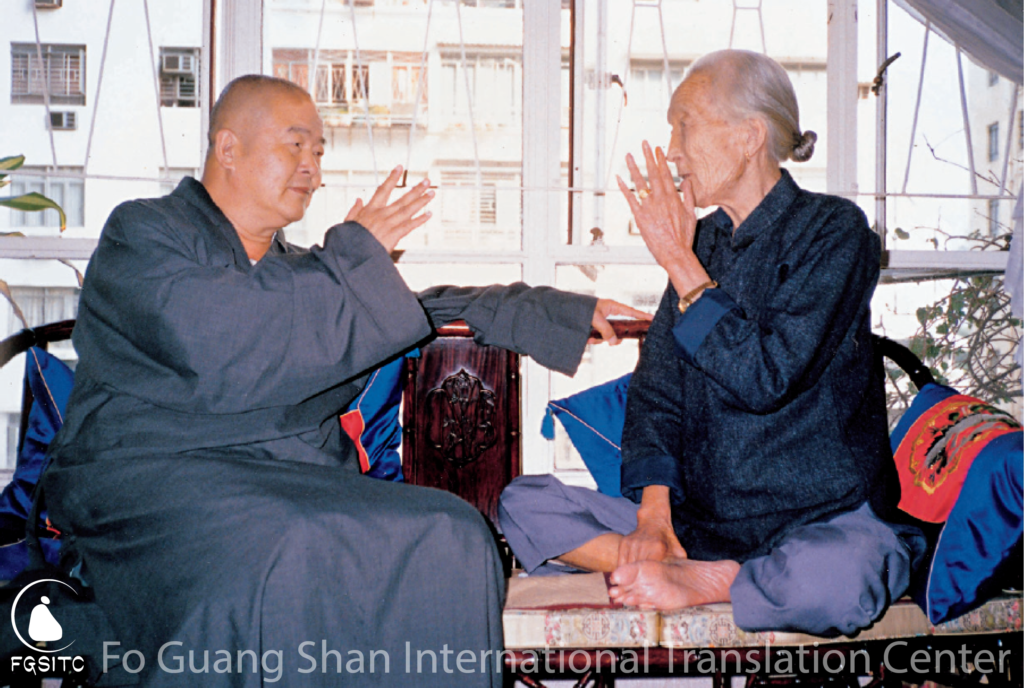
The Venerable Master is his mother’s audience.
1994

Throughout her life, there were a few events that made my mother proud. In 1990, my mother was finally able to come to Taiwan and visit Fo Guang Shan, which was founded by her son. At the Devotees’ Gathering of twenty thousand people, everyone warmly cheered loudly to her, “Hello, Grandma!” She had never experienced such a scene in her life, yet she neither had stage fright nor became flustered. She happily waved both hands in a warm and lively manner as she greeted everybody. Then she gave everyone a short teaching in the Yangzhou dialect, and I acted as my mother’s interpreter. She said:

Fo Guang Shan is indeed the Pure Land of Ultimate Bliss; heaven is here in the human world. I hope that everybody will practice well. In the past, Guanyin Bodhisattva attained enlightenment on the great Mount Gandha, and I hope that everyone will gain enlightenment at Fo Guang Shan. Everyone has been so good to me, but I have nothing to give you all, so I can only give my son to everybody.

She was true to her words and diligently put them into prac­tice her whole life. Staying happy with a simple life, being content, and even “deriving moral courage from poverty and destitution” constitute the best portrayal of my mother’s life. Her dignified presence and the courage to stand up for what is right can be said to represent the two characteristics with which she was born.

One day, at Hsi Lai Temple’s Buddha Hall in the United States, I said, “Let me light the incense for you to worship the Buddha.”

My mother replied, “Why would the Buddha want our incense? Why would he want our flowers? The Buddha only wants the simple heart of us ordinary people.” When I was with my mother, she usually held forth on the Dharma while I listened with respectful attention.

There was also one time at Hsi Lai Temple, I was giving a talk on The Diamond Sutra, and I did not know that my mother was sitting at the back listening. She waited until I came down to criticize me for speaking in such arcane terms. How could I have told everyone “no notion of self, no notion of others, no notion of sentient beings, no notion of longevity?” No notion of self is all that needed to be said. If one went on with no no­tion of others, then there is no one else to look upon or think about, so what would be the point of practice?

Upon hearing this from my mother, I was at a loss for words. At the same time, I also grasped that my mother’s in­sistence on “having a notion of others” precisely clarified the Humanistic Buddhism that I was endeavoring to carry out. My mother explained the Dharma for us; it can be said that she was a classic of “the study of humanity,” as she wanted us to see sentient beings and to bear sentient beings in our heart.

  • My Hometown Yangzhou and the Seat of My Lineage

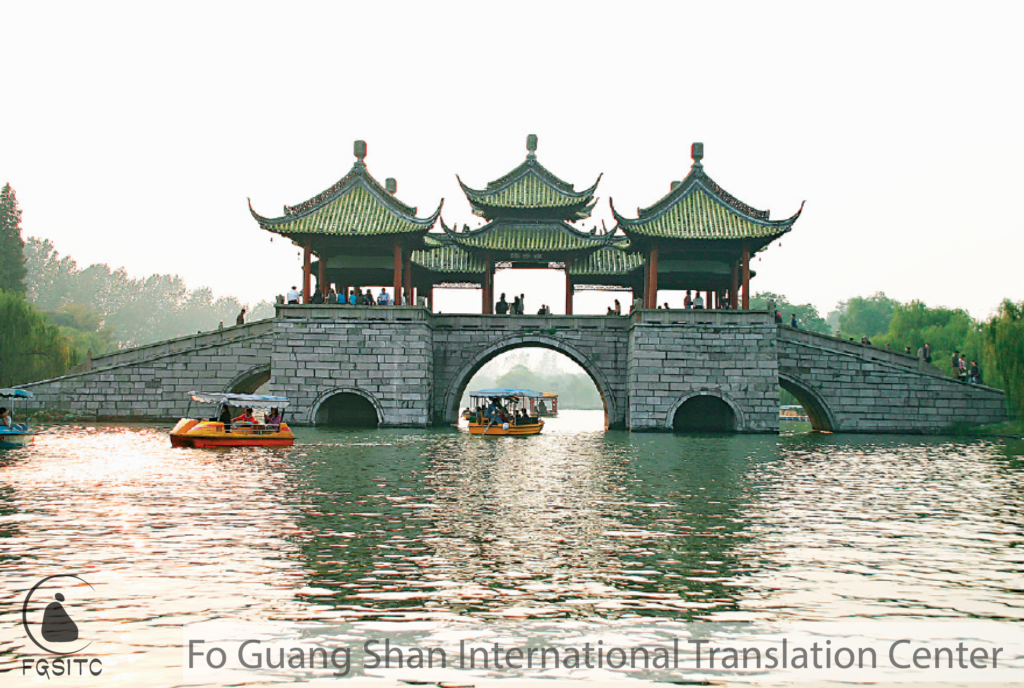
Symbol of Yangzhou: the Five-Pavilion Bridge.
Photo by Venerable Hui Yan

Yangzhou is the hometown of my parents; including my child­hood and early teens, I spent some twelve years in total living in Yangzhou. When I was a bit older, I traveled and studied at Qixia Monastery in Nanjing and other famous ancient temples and Buddhist colleges for another twelve years. I arrived in Taiwan in 1949. It was not until seventy years later when I looked back on the past that I had a sense of how the local 

conditions and customs along the Yangtze River fostered within me the language and character of the Yangzhou people. The rains and grain of Taiwan also nurtured me, enabling me to “establish a foothold in Taiwan, and keep China in my heart, walking toward the world.”

Before I turned fifty, all my work of propagating Buddhism had been focused on various countries throughout Asia, such as Hong Kong, Malaysia, Singapore, Thailand, the Philippines, India, Japan, and so on. It was not until the age of fifty that I went to the United States and made preparations to build temples and house monastics. By the age of seventy, I had been to Europe, Australia, South America, and Africa. In this way, I seemed to be moving farther and farther away from my feel­ings for my native land. Often people would ask me, “Where are you going?” My answers were always, “I am going back to mainland China,” “I am going back to Taiwan,” “I am going back to Hong Kong,” “I am going back to the United States,” “I am going back to Europe,” or “I am going back to Australia”—even to the point that every stretch of land around the globe is a “hometown” that I would be going back home to.

My entire life had been deeply influenced by my maternal grandmother, along with the addition of the causes and condi­tions for the Buddhist faith. From a young age, I understood that human life in this world need not demand a rigid adher­ence to a certain person, a certain activity, or a certain place. In 1989, after a forty-year separation, I returned to Yangzhou for the first time. At the time, I was sixty-three years old. Someone asked me, “How do you feel?” I said:

Seeing the old ladies, I feel like I am seeing the shadow of my maternal grandmother; seeing the women and men, I feel like I am seeing the appearances of my mother and father; seeing the young people, I feel like I am seeing the figures of my classmates back then. This is the feeling I have upon setting foot in Yangzhou and returning home.

Later on, I saw a document, the Local Annals compiled in 1696, which recorded how Taiwan in those days was once under the jurisdiction of Yangzhou. I could not help but feel delighted, because all along for the past seventy years, I had never really left Yangzhou.

Chapter subheadings:

    • My Father, Mr. Li Chengbao
    • My Mother, Liu Yuying—The Grandma of a Big Family
    • My Maternal Grandmother, Mrs. Liu, née Wang
    • My Hometown Yangzhou and the Seat of My Lineage

The Author’s Preface, Forewords, Afterword, and Chinese Editor’s Remarks are available to read online.

Chapter Previews from I Am Not a Monk "Sponging Off" Buddhism:

Language: English Request a copy Traveling to the Other Shore:Buddha’s Stories on the Six Perfections佛陀: 六波羅蜜的啟示by Venerable Master Hsing YunThese
Le Sūtra de Vimalakīrti 在人間歡喜修行-維摩詰經(法文版) (Practicing Joyfully in the Human World: The Vimalakirti Sutra) The Vimalakirti Sutra is an important
Chinese w/ Pinyin, digital edition The Great Compassion Mantra大悲咒Please enjoy this Chinese with Pinyin digital edition.The Great Compassion Mantra is
English only digital edition The Heart Sutra般若波羅蜜多心經This translation was originally published in The Lotus Sutra’s Universal Gate Chapter on Avalokitesvara
On March 8th, Fo Guang Shan International Translation Center held the first Buddhism Friendship Scholarship Workshop of 2025 at Hsi
恭讀佛光山開山祖師星雲大師〈為大地震祈願文〉2025.3.29慈悲偉大的佛陀!三月二十八日中午,緬甸、泰國地區發生大地震了!您可曾聽到苦難眾生的呼號?您可曾看到親人離散的慘痛?佛陀啊!佛陀!那是人間地獄發出的哀嚎!那是娑婆浩劫傳出的聲音!慈悲偉大的佛陀!那裡,山崩地裂,房倒屋毀,那裡,樓倒人亡,觸目驚心; 多少人身陷災區中,日夜恐慌; 多少人困在危地裡,無法出離。在一夕間,骨肉離散,天人永隔;在剎那間,家園全毀,財物盡失。他們多麼需要救難人員及時來到!他們多麼需要佛陀您加持與庇護!他們有的不幸罹難了,他們有的無辜傷殘了。 慈悲偉大的佛陀!祈求您的加被, 讓他們生者消災免難,健康如昔; 讓他們亡者往生佛國,蓮登九品。慈悲偉大的佛陀!請求您讓他們都能體悟: 現實的家園會有成住壞空, 自己的本性才能永恆安住;請求您讓他們都能了解: 即使骨肉至親,也會有生離死別, 只有證悟解脫,才是究竟的依靠。慈悲偉大的佛陀!請求您庇佑劫後餘生的人們,賜給他們再生的信心, 讓他們知道:活著就有希望;賜給他們向前的勇氣, 讓他們明白:生存就是力量。慈悲偉大的佛陀!請您給他們福佑, 讓他們身心的創傷趕快轉危為安; 讓他們悲痛的情緒得到轉苦為樂。請求您讓他們明白, 唯有振作精神,重整家園, 才能讓亡者得到最大的安慰, 才能讓自己得到最後的成功。我們更祈求, 這次的災情不要再擴大, 類似的禍害不要再發生。更祈求您加被所有的民眾,讓大家都知道 一定要在平時做好防範工作,讓大家都體會 必須要互助合作,居安思危。慈悲偉大的佛陀!請求您接受我至誠的祈願,請求您接受我至誠的祈願。A Prayer for Victims of the 2025 Myanmar EarthquakeBy Venerable Master Hsing YunFounding Master of Fo Guang ShanAt midday on
Available in English & Chinese w/ pinyin Request a copy The Sumati Sutra as Discoursed by the Buddha佛說妙慧童女經In The Sumati
The original article was published in The Merit Times. Fo Guang Shan Hsi Lai TempleOctober 16, 2024 Venerable Hui Shiuan, Director
Oh great, compassionate Medicine Buddha! Please listen to my report: There is truly too much suffering in the world these
佛教友誼獎學金 培育多元國際弘法青年The original Chinese article was published in The Merit Times. Fo Guang Shan Hsi Lai TempleMarch 16, 2024 Radiating unity and

More Featured Articles

Many of us think that after undertaking the precepts life will become a matter of you-can’t-do-this and you-can’t-do-that. We wonder if that isn’t limiting us even more. We worry that it will mean a loss of freedom. This is why some people will question: Why should I receive the precepts and end up just limiting myself!In fact, if we were to go to a prison Read more
Anger is distinguished from greed in that anger is a form of revulsion created by something we do not like while greed is a form of attraction brought on by something we do like. In this limited sense, and in this sense only, greed can be said to be “better than” anger. Greed at least has some positive components while anger generally has none at Read more
Our emotions are a very important part of our everyday life, and they star in a leading role on the stage of relationships. The ability to feel and our freedom to act upon these feelings give us both joy and sorrow, and it is imperative that we maintain our emotional well-being to minimize the potential for suffering within relationships. Emotions are the glue that bind Read more