
Better Silent than Noisy

mushroom-2921176_640

One year, during the summer retreat[1] at Lingshu Monastery, King Liu of the Later Han[2] of the Five Dynasties Period insisted on inviting Chan Master Yunmen and the entire community of the monastery to pass the summer in his palace.

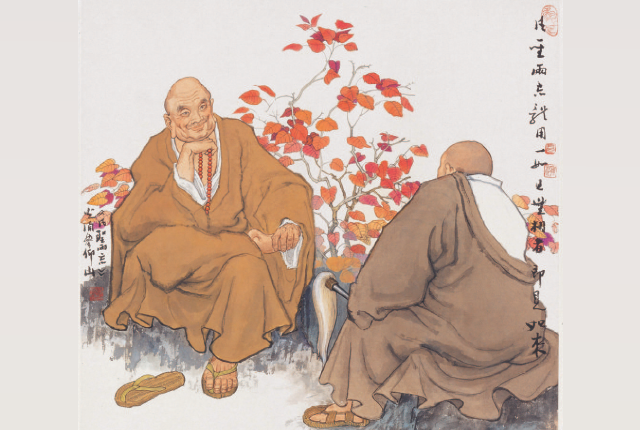
At the palace, several monks received the court ladies paying their respects and inquiring about the Dharma. The women gathered together chattering pleasantly, so it was very noisy. Especially since King Liu was devout and valued the Dharma, not a day passed without the practice of Chan meditation and lectures. The elders of the monastery were also happy to give Dharma talks to the court ladies and eunuchs. However, only Chan Master Yunmen sat alone meditating silently to the side. As a result, the court ladies did not dare to get close and ask for instruction.

There was an official on duty at the palace who often saw this kind of situation, so he asked Chan Master Yunmen for instruction on the essentials of the Dharma. Chan Master Yunmen always remained silent.  Not only was the palace official not offended, he was even more respectful. On the front of Biyu Hall, he posted a poem that said: 

The cultivation of great wisdom begins with Chan,

In the Chan gate, it is better to be silent, not noisy.

All the clever ways of speaking, competing for the Truth,[3]

Still defeated by the “non-speaking” of the Chan gate.

Master Hsing Yun’s commentary:

The great masters of the Chan School have always been like leisurely clouds and wild cranes, sometimes dwelling in the mountain forests, sometimes living by the water.  With three robes and one mat, they follow their conditions and let things follow their own course.  Even when their Dharma conditions are remarkable or they are among royalty, they are not tempted by material gain or moved by power. 

Just as in Chan Master Yunmen’s “a moment of silence, a clap of thunder,” even though no words are spoken, his instructions are like thunder rumbling over our heads.  If we understand the countless insights in our hearts when we are in silence, then it can be said that we have penetrated a little bit of Chan.

Notes:

  1. The summer retreat is a practice that has been passed down as the “rainy season retreat” since Sakyamuni Buddha’s time in India. It refers to the period when Buddhist monks stopped their travels and outdoor activities for the duration of the summer rainy season and gathered at a sheltered location to devote themselves to study and discipline.
  2. The Later Han of the Five Dynasties Period lasted from 947-950 C.E. and was the fourth of the Five Dynasties. The Later Han was a tumultuous period marked by continuous wars and division in the country.
  3. “Truth” means the supramundane truth.

More Featured Articles

Birth and death are realities of life. Regardless of who we are, we cannot escape either one. While birth is celebrated, death is feared by most. In order to cope with our fear, we often seek comfort in religion. Although each of the world's major religious traditions has its own teaching concerning death, Buddhism is the only one that promotes the doctrine of impermanence as one Read more
In the past, during the feudal period of Chinese history, men were respected while women were thought of as being rather contemptible. The birth of a son was compared to fashioning an ornament as precious as jade, which not only made everyone happy, but also raised the status of his mother. Read more
Technological progress and advances in modern science have led to material improvements that have enhanced the quality of people’s lives on many levels. Yet, no matter how much we have progressed or how advanced our technology is, there still remain fundamental problems in life that science will never be able to solve.Two of the greatest problems people face are birth and death. No sooner are Read more
Master Zhiyi’s “six wonderful methods” describe four different kinds of specialized breathing: bellowing winds, broken panting, low-pitched breathing, and internalized breathing.1. Bellowing Winds“Bellowing Winds” describes when one’s inhalations become more and more powerful. As the breathing becomes deeper and longer it can become very loud. This is because, once the power of one’s concentration has been gathered, it can be transferred elsewhere with great force. Read more
At the many places I engaged in practice and study—at places such as Qixia in Nanjing, Jinshan and Jiaoshan in Zhenjiang, and Tianning in Changzhou, where I was brought up experiencing spring breezes, summer rains, autumn frosts, and winter snows—I studied silently and grew up quietly. I was always thinking as to how I could repay Buddhism’s kindness. I could not make a living by depending on Buddhism over Read more
Many of us think that after undertaking the precepts life will become a matter of you-can’t-do-this and you-can’t-do-that. We wonder if that isn’t limiting us even more. We worry that it will mean a loss of freedom. This is why some people will question: Why should I receive the precepts and end up just limiting myself!In fact, if we were to go to a prison Read more
We sometimes see signs on the highway warning: “Keep a safe distance.” Actually, it is not only in driving that we need to keep a distance. For safety reasons, any person and anything in the world needs to keep a distance.Take, for instance, the human body. Our eyes, nose, and mouth all need to keep a distance from one another. Our internal organs all have Read more
The Sumati Sutra discusses fulfilling both worldly and supramundane needs. Sumati’s first three questions are regarding obtaining an elegant appearance, obtaining wealth, and keeping a harmonious family life—all of these are concerned with success in this life. Being satisfied in this way ensures that a bodhisattva will not be hindered, and can freely walk the bodhisattva path.Rewards and blessings are not stolen, forcibly taken, or Read more
Social harmony stems from handling relationships and communal living with skill, effort, and a spirit of cooperation. We can learn a lot about keeping peace in social living from the six points of reverent harmony that the monastic sangha observes. Sangha is a Sanskrit word, which can be interpreted on many different levels. In its widest interpretation, it refers to all those who have the Read more
Everyone in this world wants to have wealth and live a carefree life. They also want a good rebirth. Richness in this life and pleasure in the next are the hallmarks of a successful life.In the Sumati Sutra, the Buddha defined a "successful life" to be wealth in this life and happiness in the next life. Having wealth in the present life includes an elegant, proper appearance, Read more
We should not look at life just as the limited span of one person’s life; we should look at the larger life of the universe. While a person’s life may only span a limited number of years, its value is everlasting. Read more
Human beings are social animals; we cannot live apart from community. As Buddhists, we are told to seek the Dharma among the people, for the Dharma does not exist in some other world or far away place; the Dharma is here among us, embodied in each and every being. When we understand that human society is nothing other than a web of human relationships, we Read more