
Highlights from the book I Am Not a Monk “Sponging Off” Buddhism, by Venerable Master Hsing Yun
My Silent Revolution
for Buddhism
In devoting my life to Buddhism, in order to keep Buddhism current with the advances in society, in terms of thoughts, I am always making improvements at every hour and moment; in terms of practice, I am constantly and continuously making adjustments. Even though I know that Buddhism must be reformed, innovation never comes into being in the heat of the moment. My “silent revolution” advocates that some things advance, while some things retreat; some things proceed, while some things stop. Although the results are not apparent immediately, I consistently work on them, which can slowly overcome any obstacle!
In the past, Venerable Master Yinguang [1862–1940] advanced the idea that Buddhism must get rid of “three excesses.”
The first is the excessive transmission of the precepts. I began conducting the Triple Platform Full Ordination Ceremony in 1977, and over the ensuing thirty-odd years, I have carried out about a dozen of these. Not only have ordinations been performed in Taiwan, but they have also been performed in countries such as the United States, India, and Australia. I ask myself, “Is this an excessive transmission of the precepts?” In fact, I do so for the sake of establishing the precept banner!
The second is the excessive providing of temple and monastery lodgings. At present, Fo Guang Shan has three to five thousand beds that can provide lodging for devotees and guests. Is this the excessive providing of temple and monastery lodgings? Not at all. I only want to ensure that everyone can participate in Dharma services, so as to foster the bodhi mind!
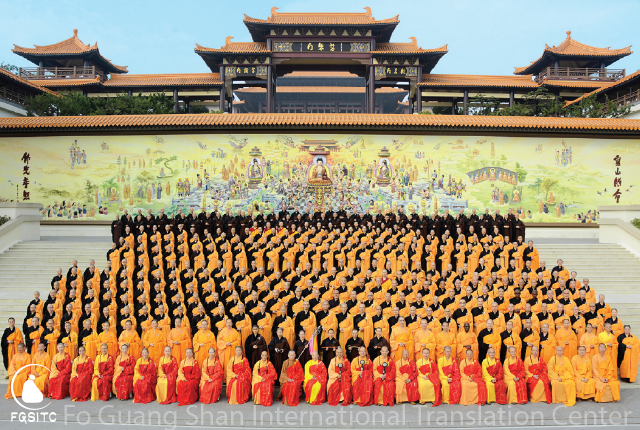
In 2016, Fo Guang Shan conducted the International Ten-Thousand-Buddhas Triple Platform Full Ordination Ceremony at Fo Guang Shan Sutra Repository.
Photo by Zhou Xuezhong
The third is the excessive acceptance of disciples. I have more than one thousand monastic disciples and several million lay devotees. Regardless of whether they are monastics or lay disciples, they have all matured in their faith, improved their character, and increased their aspiration to serve daily. Am I excessively accepting disciples? Not at all. I am continuing the life of Buddha’s wisdom!
Therefore, as for the “three excesses” raised by Venerable Master Yinguang, it would seem that all of these three do apply to me, but I feel that I am not in any way “excessive.”
I am very careful about transmitting the precepts; I am very cautious about providing lodgings; I am also very judicious about accepting disciples into the monastic community.
In addition, Venerable Master Taixu proposed the “three-point revolution” for the sake of Buddhism’s renaissance. The first is revolution on doctrine; the second is revolution on the system, and the third is revolution on property. I too have kept the three-point revolution in mind, for I have firmly combined it with my own thinking. Moreover, I have unremittingly persevered in putting it into practice as the “silent revolution.”
When it comes to “revolution,” most people are afraid upon hearing the word, thinking it is about overthrowing and attacking other people. In fact, the “silent revolution” I am talking about abounds with constructive and progressive qualities, signifying the removal of corruption and the bringing about of a renewal. It is a kind of reformation that everyone can happily accept without realizing it. Thus, how can advancing Buddhism’s development by means of a “silent revolution” not be something quite significant?
- First: Revolution on Doctrine
In the past, whenever money is mentioned, some Buddhists would say, “Gold is a poisonous snake.” Whenever husbands and wives are mentioned, some Buddhists would say, “If they were not foes in past lives, then they would not have gotten together.” And whenever children are mentioned, some Buddhists would say, “Children are debt collectors.” In fact, Buddhism does not completely negate money, for pure wealth provides the supplies needed to propagate the Dharma and cultivate enlightenment. Buddhism in no way fails to value moral principles; moreover, it actively advocates the morality of human relations. Buddhism is not critical of the emotional bonds of the family but wants to be an advocate for the building of happy, harmonious, and purified family relationships.
- Second: Revolution on the System
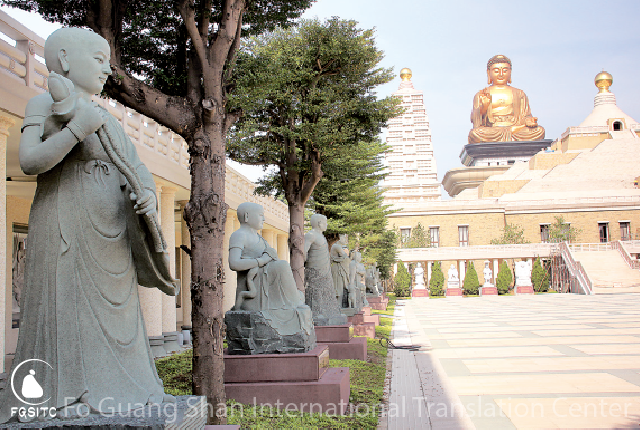
There are three female arhats among the eighteen arhat statues at the Buddha Museum, demonstrating that there is no difference between males and females regarding enlightenment. The photo on the left is Utpalavarna Bhiksuni.
Photo by Venerable Hui Yan
Regarding the threefold training of morality, meditative concentration, and wisdom, Buddhists regard morality as the highest of all. Regrettably, nowadays there are some people who love to quote the phrase “The precepts already formulated by the Buddha cannot be changed; where the Buddha did not formulate precepts, no additions can be made.” This makes the Buddhist teachings into something rigidly fixed. In fact, the Buddha formulated the precepts “prohibiting and permitting in accordance with the circumstances.”
They evolved in accordance with the time, the human heart, lifestyle, culture, and customs. If one were to insist that the precepts be immutable and unalterable, it would create too much opposition and contradiction between upholding precepts and not upholding precepts, as well as between defiance and compliance; then Buddhism would perish under the weight of inflexible interpretation of the wording of the precepts!
- Third: Revolution on Property
When Buddhism was first transmitted to China, as soon as a temple or monastery was built, the monarch and his great ministers who were believers in Buddhism would all vie with one another to make offerings to the Triple Gem, to the point that Buddhism was amassing more and more wealth. Over time, this often attracted the envy and suspicions of society and the bureaucratic system, which eventually triggered a crisis. Even today, there are some temples and monasteries that are still harassed at every turn by some local officials because of the prosperity brought about by the offerings of incense and candles to the temple. Actually, when the monastics possess wealth, they do not shift it over for personal use, nor do they take it back to their secular families for their use. All of it is employed to propagate the Dharma, to benefit sentient beings, and to improve social welfare. So why can they not have a proper economic life? Then again, if the temples and monasteries are lacking in pure wealth, how can they undertake so many Buddhist projects and further benefit the masses?
Chapter subheadings:
- First: Revolution on Doctrine
-Gold Is a Poisonous Snake; Husbands and Wives Are Karmic Foes; Children Are Debt Collectors
-Life Is Suffering
-The Emptiness of the Four -Great Elements
-Impermanence
-The Release of Life
-The Three Acts of Goodness
-Do Not Make Amitabha Buddha Pay Kindness on Our Behalf
-Taking Refuge in the Triple Gem, Receiving the Five Precepts - Second: Revolution on the System
-Equality of the Fourfold Assembly
-The Six Points of Reverent Harmony
-Wearing the Robe to One Side While Exposing the -Right Shoulder
-The Eight Precepts of Respect
-The Ten Precepts of the Sramanera
-No Meals After Noontime
-The Master-Disciple Relationship in Buddhism - Third: Revolution on Property
1) Dharma Service and Donations
2) Buddhist Sutra Chanting and Repentance Activities
3) The Four Offerings
4) Making Affinities to Maintain a Living
5) Income from Building Rentals
6) The Arts of Painting and Calligraphy
7) The Distribution of Dharma Supplies
8) Vegetarian Meals
9) The Work of Propagating the Dharma
10) Sightseeing and Pilgrimages
- First: Revolution on Doctrine
The Author’s Preface, Forewords, Afterword, and Chinese Editor’s Remarks are available to read online.
Chapter Previews from I Am Not a Monk “Sponging Off” Buddhism:
Get updates and additional content by following us on Facebook and Instagram:

