
Highlights from the book I Am Not a Monk “Sponging Off” Buddhism, by Venerable Master Hsing Yun
My Realization Concerning
Humanistic Buddhism
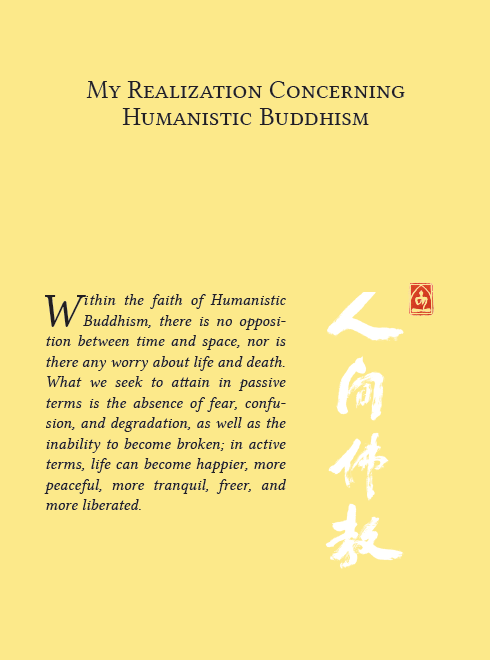
Within the faith of Humanistic Buddhism, there is no opposition between time and space, nor is there any worry about life and death. What we seek to attain in passive terms is the absence of fear, confusion, and degradation, as well as the inability to become broken; in active terms, life can become happier, more peaceful, more tranquil, freer, and more liberated.
As for Humanistic Buddhism’s development up to now, there are some who do not understand Humanistic Buddhism and who therefore have some doubts about it. Here, I will list some concerns that have been raised regarding Humanistic Buddhism:
1) Humanistic Buddhism is vulgar, worldly, and of humans; it does not reach the highest state of Buddhahood.
2) Humanistic Buddhism attaches importance to worldly activities; these activities have nothing to do with learning Buddhism.
3) Humanistic Buddhism has no spiritual cultivation; at most, it is all about how individuals conduct themselves in society. This bears no relationship to such possibilities for transcendence, elevation, and becoming a Buddha through learning Buddhism.
4) Humanistic Buddhism is oriented toward the laity, being without the sacredness of the life of the monastic community or enlightenment through ascetic practice.
5) What is the heritage of Humanistic Buddhism and what does it impart? There is no sense of anyone having attained accomplishment in cultivation, and because no one knows, it is not easily propagated.
. . .
The above are criticisms of Humanistic Buddhism. Moreover, there are many other perceived problems including tradition versus modernism, the laity versus the monastic order, monasticism versus society, the original versus the recent, spiritual cultivation versus activism, and so on. None of these generally lend themselves to being understood by the people. As a consequence, there is a need to further strengthen the popularization of Humanistic Buddhism.
There was a time when Buddhism retreated to secluded practice and lost the Buddhist spirit of engaging in the world. Buddhism retreated to the forest and mountain and lost its service toward the devotees. Buddhism retreated to mystic talks and lost the practical application of Buddhism’s undertakings. Buddhism retreated into giving passive teachings and lost its true meaning of active improvement. Now I hope to recover the genuine meaning of Buddhism’s original intent.
The twenty points listed below pertain to what Humanistic Buddhism means.
1) Our Humanistic Buddhism must elevate us and affirm us, in that we possess the wisdom and excellent qualities of the Buddha by acknowledging that “I am a Buddha.” This kind of self-elevation is precisely the spirit of Humanistic Buddhism. This is not giving ourselves over to the control of religious authority, rather, we assume responsibility for everything concerning ourselves. This is just as stated in The Connected Discourses: “Rely on yourself, rely on the Dharma, and rely on nothing else.” This is our faith in Humanistic Buddhism.
2) The spirit of Humanistic Buddhism encourages us to integrate others into ourselves. There is no opposition among us. We and others are not two, therefore all sentient beings are one; everything in this world is related to us. We believe that the Middle Way and dependent origination, which the Buddha is enlightened to, is the truth of Humanistic Buddhism; and that truth, which we have inherited and now impart, is the faith of Humanistic Buddhism.
3) Faith is something complex and multifaceted. However, in terms of its meaning, Humanistic Buddhism is able to unify these many complexities because the source of our Buddha nature can accomplish everything. Despite the differing levels of faith and multiplicity of its categorization, Humanistic Buddhism can fulfill all religious teachings. This is the magnanimity of Humanistic Buddhism, which can also serve as the faith of all humanity.
4) The faith of Humanistic Buddhism holds that life is eternal, as it cannot die. Those who believe this can attain liberation, but those who don’t believe this will not perish either. It is comparable to a clock that tells time, which is circular in shape and not a straight line. In a straight line, one proceeds from birth to death, and then there is nothing. But a clock is circular in shape, so after twelve o’clock, it starts from one o’clock again as usual, circling about forever. It is also comparable to the four seasons of spring, summer, autumn, and winter; or how material things have their formation, abiding, destruction, and void; how mental thoughts have their arising, abiding, change, and extinction; and how the physical body has its aging, sickness, death, and rebirth. It is because of death that there can be birth, so there can then be a future and hope.
Hence, I feel that Buddhism’s view of the cycle of birth and death is one of a limitless future. From now on, Humanistic Buddhism does not emphasize the “six realms of existence.” In appearance, there should not be a rigid boundary separating the sacred from the secular. Since everybody is inherently a Buddha, why is it necessary to divide them into so many categories? We call it “cycling through the ten Dharma realms.” This then is what Humanistic Buddhism advocates.
. . .
The Author’s Preface, Forewords, Afterword, and Chinese Editor’s Remarks are available to read online.
Chapter Previews from I Am Not a Monk “Sponging Off” Buddhism:
Get updates and additional content by following us on Facebook and Instagram:


Pingback: MI COMPRENSIÓN SOBRE EL BUDISMO HUMANISTA – Budismo Humanista